Museum of Future Experiences presents Liminality, a virtual reality and sonic exhibit which is just as disruptive as it is comforting.
Museum of Future Experiences presents Liminality, a virtual reality and sonic exhibit which is just as disruptive as it is comforting.
Liminality is defined as a state of uncertainty that arises from, “a phase in [which] one is not who they once were and not yet who they will become”. This is a process every person has encountered to some extent, one which comes naturally with the course of life, and especially so within the past year. This topicality is a double-edged sword, having the potential to be impactful in its universality while also having the ability to revisit realities we are exhausted of facing.
Comfort is a state of being that I was surprised to find myself in my first initial moments entering MoFE. As the only patron who had arrived on their own there was a small part of me, amidst the chatter of the grouped and paired guests, that was afraid I might miss out on an aspect of shared experience. Groups of noise in between silences of inspections of the trinkets and oddities we were encouraged to explore, reminded me of waiting in line for a themed roller coaster, scanning the room with an underlying curiosity of what was to come.
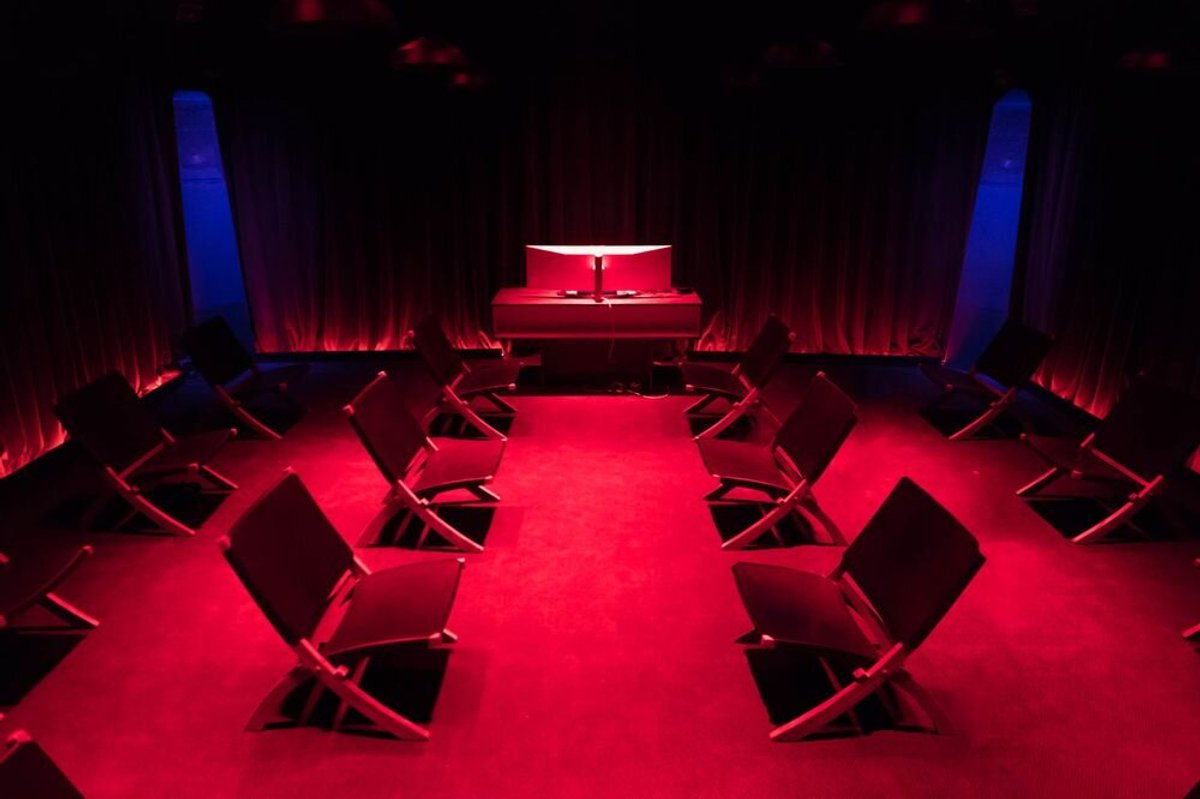
Once I was led into the theatre, this fear of missing out was easily dissipated by the room’s intimate spaciousness. As the lights dimmed the distance between seats seemed to widen, thickening the air with the silence of spectators. Without a screen to turn to, the looming presence of what was to come visualized itself in the monument-like pillars which resided at each of four corners of the room. Illuminated in soft purple lights, the speakers at rest served as invitations for the sonic landscapes that were to come.
(Source)
The ritual that had been observed, waiting to be seated before luscious curtains, was reminiscent of a theatrical experience. This was subverted by the unorthodox arrangement of the theatre —curtains acting as walls, and half of the audience facing the other—a contributor to the allure of the experience. Even with the fixed nature of the show, calculated order and execution of pieces, the space facilitates an immersive environment in which the individual can also be impactful.
There is even something to be said about how the circumstantial addition of masks adds to the equation. Headset and mask on, I felt as though an entire sense had been blocked off, airflow constrained within small gaps of air. In this awareness, virtual reality served to separate me from the space in which my body resided. Even in moments that could have broken the illusion, the shifting in my seat for comfort, the transitions between pieces, the odd sound heard beyond the headset, this capsule kept me reeled in. Momentarily blind to our physical attachments to the world, bodily presence becomes only but a beacon for sensory reception. Most tantalizing, however, is the ways in which this illusion continues even beyond the virtual reality cocoon.
Having a physical digital apparatus encasing a reality is one thing, introducing a reality into a physical space is another. The MoFE ambisonic systems allow for a rich and complex sound environment in which we are not just listeners of sound, but one with it even in our silence. A traveler in a sonic landscape, I found myself trying to tune into where I was residing within the sound. In the depths of a haunting cave, was I a third companion to the people conversing within it or the cave itself? Was I the rider of a boat during a storm or the waves thrashing against the hull of the ship? Even in moments in which I was reminded that I was in a world that was not all my own, this individualizing experience of being within tethered me to these realms.
In some ways, this fantasy that one becomes entangled with makes up for breaks of the illusion existing within the content itself. Moments in which stories might feel a bit cliched or existentially forced are softened by the marveling of the technological advancements of presentation. It is the glimpses into approaches and thematic abstractions that are more intangible that make me wish I could return again and again. Fragments of this sort of awe, drawing both in and from the spectator, make for an experience that is emotionally enriching beyond what the story itself provides. In moments of shortcoming in this regard, there still lies a hopeful optimism for the depths to which this form of digital storytelling can achieve as it continues to develop.
The show’s understanding of its potential, to resonate in ways that other forms of technologically reliant entertainment might not be able to, is what makes for the uniqueness of the experience. It is what makes Liminality in both content and form a show which is properly conducive for a post-pandemic climate fraught with a mixture of hopeful ignorance and cautious uncertainty. Leaving the exhibit, floating through Williamsburg’s streets, I continued to carry the experience with me—learning to listen again without thinking of how I should mentally construct the landscape, or which speaker I should be listening from—slowly returning once again to my bodily form.

